Thomas Kehoe, Terry Slevin, Kate Broun, and Craig Sinclair
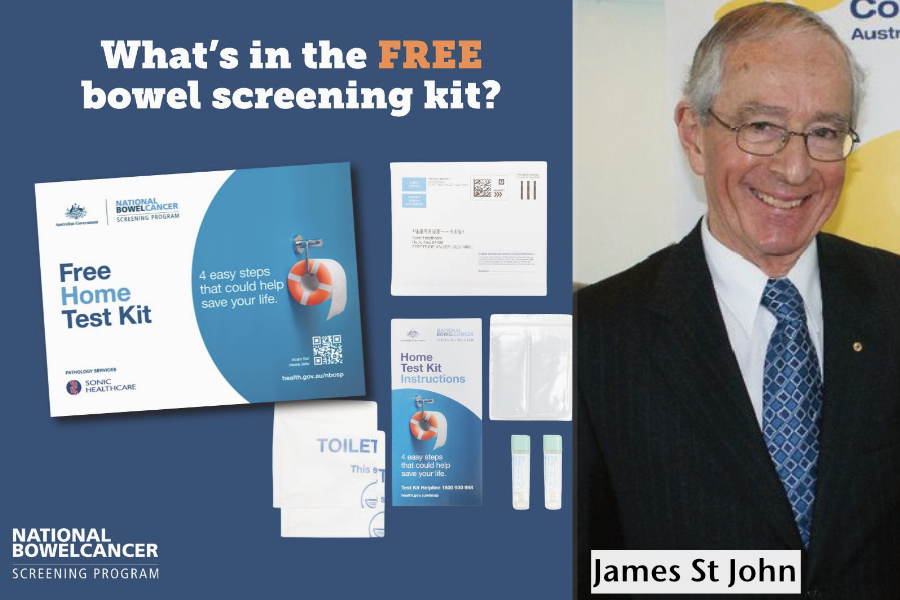
Professor Donald James St John AO (“Jim”) passed away on Monday 25 August. A brilliant clinician, scientist, and advocate for public health. His five-decade-long, distinguished career in gastroenterology contributed to establishing the National Bowel Cancer Screening Program, which has saved thousands of Australian lives. Vale Jim St John.
Astonishingly humble and consequently reticent to explain his passion for bowel screening, when Cancer Council Victoria historian Thomas Kehoe asked about it in an interview, he responded characteristically, “Don’t ask me that!” before saying: “I suppose it was just because I always loved the bowel.”
An early commitment to medicine and public health
Jim was born in Melbourne in 1936, graduated in medicine at the University of Melbourne in 1959, and was resident at the Alfred Hospital before traveling to Guy’s Hospital in London to specialise in gastroenterology.
Jim recalled that in the 1960s and ’70s, few gastroenterologists were interested in bowel cancer or in performing colonoscopy, preferring instead to transfer patients to oncology on diagnosis. But in 1967, Ohio-based physician David Greegor showed how searching for hidden (‘occult’) blood in stool showed potential for identifying asymptomatic bowel cancer.
Jim was an early convert. In the 1970s, he became involved in clinical studies on the efficacy of using the Faecal Occult Blood Test (FOBT) as a mass screening tool. He quickly came to believe later that it could have the same effect for bowel cancer as the smear test for cervical cancer. His research was critical in determining that the more easily performed immunochemical FOBT was superior to the guaiac-based approach. The iFOBT was subsequently selected for Australia’s national screening program.
Convincing the skeptical
He was surprised that many medical organisations continued to neglect bowel cancer through the 1980s, despite it being “the second commonest cause of death from cancer” according to Progress towards a National Bowel Cancer Screening Program for Australia report. In his view, too many clinicians and public health leaders viewed it as controversial, and he became committed to changing minds.
But it was not until 1990 that a sufficiently robust evidence base was developed, and he could describe how and when bowel cancer screening should be used. In 1991, Jim and colleagues Finlay Macrae and Graeme Young developed guidelines that were then released by the Australian Gastroenterology Institute. On preliminary positive results from international randomised controlled trials, the Australian Cancer Society (now Cancer Council Australia) held a national conference on bowel cancer screening in August 1993, which led to the publication of updated guidelines in November 1994.
Jim was then central to advocating for the creation of a pilot program to then Health Minister Carmen Lawrence using evidence from studies in Minnesota, Nottingham, and Funen. On 5 July 1995, Minister Lawrence created a bowel cancer screening working party to investigate developing a population-based screening program. Jim was appointed Deputy Chair.
On the committee, Jim stayed abreast of the developing science. In 1998, the group recommended national bowel screening using the iFOBT. In 2001, then Health Minister Michael Wooldridge launched the four-year pilot – National Bowel Cancer Screening Program. Jim kept the relevant media release in his files circling the government’s acceptance of the 50 to 74 age range for which he had long advocated.
Maintaining commitment after retirement
Jim maintained his advocacy for national bowel screening even after retiring from the Royal Melbourne Hospital. He even undertook a higher research degree on the science and benefits of bowel cancer screening. The Howard Government’s national program in 2006 was a milestone achievement in the fight against bowel cancer. Since it was introduced in phases, Jim maintained his advocacy for universal access.
By mid-2010, the value of Jim’s commitment to the science and medicine of bowel cancer screening was getting widely recognised. In 2014, he was inducted into the Royal Melbourne Hospital’s Research Hall of Fame. In 2016, the University of Melbourne awarded him an honorary doctorate in large part for making national bowel cancer screening a reality.
When the program reached universal biennial screening for people aged 50 to 74 in 2019, then Health Minister Greg Hunt announced the achievement and praised Jim as “the founding father of bowel cancer screening”.
Still, Jim continued to push for the program to evolve and follow the evidence. When interviewed in 2023, Jim was vocal about the need for expanding program eligibility by lowering the screening age to 45 years. This was realised in July 2024.
In a testament to Jim, Australia now has one of the world’s most effective bowel cancer screening programs. Since 2006, 12.8 million tests have been completed; 5.1 million people have participated at least once, and 16,809 bowel cancers have been diagnosed. Analysis shows that diagnosed participants were likely to have had their cancer detected earlier and had a lower risk of mortality.
Still, higher uptake is needed. Until the end of his life, participation remained a concern for Jim. If national participation increased to 60%, Jim dedicated his life to this vision. It is on all of us—policy makers, health professionals, and the community—to see it realised.
“Jim St John was a wonderful, gentle self-effacing but effective leader who drove reform that saved thousands of lives,” said Adj Prof Terry Slevin, CEO of PHAA.
“Most people spared the ravages of advanced bowel cancer will never know of the bullet they dodged due to his dedicated work. My own brother is in that category.
“An outstanding contribution from one of nature’s gentlemen. Vale Jim St John. You left the world a better place.”
Adj Prof Terry Slevin is PHAA’s CEO. Dr Thomas Kehoe is Historian and Manager of Heritage at Cancer Council Victoria. Ms Kate Broun is Head of Screening, Early Detection, and Immunisation at Cancer Council Victoria. A/Prof Craig Sinclair is Director of Prevention at Cancer Council Victoria.
Leave a Reply