Jane Martin, Katarnya Hickey, and Rosie Hart
If you know school aged children, you likely know about Minecraft. It’s an online, multi-player game that allows children to be creative while building and exploring in a safe and relatively open-ended space. Australian kids love it. Research from New Media & Society shows two thirds of children aged 9-12 played Minecraft at least once a month.
Big brands know kids love this game, too. Minecraft mania hit a new dimension with the release of A Minecraft Movie, which has earned at least $816 million globally at the box office. Major brands pushed to get in front of game fans. McDonald’s launched one of its biggest campaigns of the year in April.
The collaboration included two exclusive meal deals within the game. One featured collectible plastic toys alongside the fast food giant’s menu items. The second promoted popular Minecraft “treasures” and a movie “happy meal”, which McDonald’s marketing said was so ‘youngest fans can join in on the fun too.’ The specialist themed toys mimicked both Minecraft characters and McDonald’s menu item brands icons – such as the ‘Big Mac Crystal’ and ‘Fry Helmet.’ Both deals promoted repeat visits and preyed on children’s engagement with Minecraft, encouraging them to go to McDonald’s or miss out.
Effectively, McDonald’s infiltrated the popular online realm of Minecraft, by creating an in-store experience embedded in the game, ingratiating themselves to children likely to be familiar with the brand. The cross-promotion included games, films, and “food”. This sophisticated, yet insidious, brand building comes with considerable influence, including a significant long-term impact on children’s health.
The campaign was more than in-store promotions. It included a scannable code for a meal game designed for young children that used McDonald’s themes and colours. It had red boxes similar to Happy Meal boxes, and items that glowed yellow when selected. These inclusions incentivised children to purchase and pester their parents for the film’s related meal, ultimately reinforcing poor diets and undermining their health.
The promotion works like this: the plastic toy features a matching card and code to scan for a Minecraft “skin” which players use in the game. If the customer used the McDonald’s app, there were also rewards which could be redeemed in the game, which included McDonald’s branded characters.
A history of similar promotions
This is another example in a long line of integrated marketing campaigns. McDonald’s had already partnered with games including Monopoly, Santa’s Little Helpers, and Pokémon. Its website currently promotes the children’s soft toy brand Squishmallows as a meal promotion. McDonald’s is not the only cross-promotion offender. Recent collaborations in Australia include the Hungry Jacks x The Garfield Movie, Arnott’s Biscuits x Bluey, and Kinder Joy x DC Comics.
How is this allowed in Australia?
Despite decades of advocacy by groups such as ours, there are no Australian Government regulations to protect children from unhealthy food marketing. Instead, the advertising industry is allowed to design its own codes for how they market unhealthy food to children. They’re not designed to stop the unhealthy food marketing that children see.
This McDonald’s and Minecraft movie campaign was no exception. In March 2025, Food for Health Alliance submitted two complaints about the campaign to Ad Standards, the industry body that assesses complaints about non-compliance with the industry code. We also cited the Food & Beverages Advertising Code set by the Australian Association of National Advertisers. Ad Standards said they could not progress the complaints, mostly because the overall campaign and the Minecraft branded McDonald’s meals, were not classified as advertising under their code.
Allowing unhealthy food companies to stave off regulation and establish their own codes of conduct for marketing to our most vulnerable Australians – children – seems misguided at best, and an impending health disaster at worst.
Why unhealthy food marketing needs to be a part of the conversation
It’s clear that this advertising effectively targets children. And governments across Australia agree that this should be a priority as a part of a suite of measures implemented under the National Obesity Strategy. It’s time the Australian Government stepped in to ensure that health is prioritised over and above profits made from promoting unhealthy foods to children.
Last year, the Australian Government consulted on a feasibility study on policy options to limit unhealthy food marketing to children. We hope that once that study is finalised, we will see a swift and strong government response.
Food for Health Alliance wants to see comprehensive and effective regulation of unhealthy food marketing that stops food companies designing promotional campaigns that link unhealthy food products and brands with popular children’s games, toys, and characters.
This is part of our efforts for a childhood free from unhealthy food marketing.
The Brands off our kids campaign urges governments to:
• Make online environments free from unhealthy food marketing;
• Ensure TV, radio and similar media are free from unhealthy food marketing at all times of the day and night when children are watching and listening;
• Make public spaces, public events and retail environments free from unhealthy food marketing; and
• Prevent companies marketing unhealthy food directly to children with tactics like cartoons on product packaging, toys, and prizes.
We encourage you to sign up to support our efforts, and use your voice.
Jane Martin is the Excecutive Manager for Food for Health Alliance (formerly the Obesity Policy Coalition).
Rosie Hart is the Policy and Advocacy Coordinator for Food for Health Alliance.
Katarnya Hickey is a Senior Legal Policy Advisor for Food for Health Alliance.
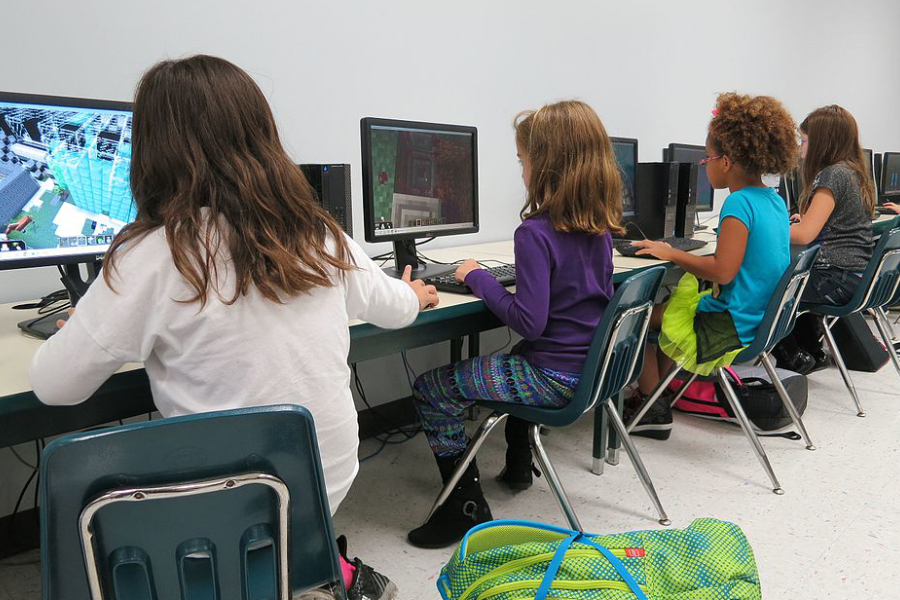
Image: Children play Minecraft in a school. Credit Kevin Jarrett from Northfield, NJ, USA /Wikimedia

Leave a Reply