Elisapeta Agnes Anitelea, Kesang Thrinlek, Tshering Denka, with support from Penelope Smith and Dr Alana Gall
The historical legacy of colonisation has profoundly influenced global health paradigms.
Indigenous communities and their leaders, who have been directly affected, are not passive recipients, but active agents in the decolonisation process.
Their resilience and determination, in the face of significant disparities in health outcomes and determinants, underscores the urgency of reforms in public health.
Decolonisation involves dismantling colonial structures that perpetuate inequities, and transforming systems or developing new structures to realise Indigenous freedom, self-determination, and wellbeing.
Emma Rawson-Te Patu, the first Indigenous President-elect of the World Federation of Public Health Associations (WFPHA), during the first Indigenous Working Group meeting in 2023, defined decolonisation as:
“an individual and collective process that requires active resistance to forces of colonialism that perpetuate the subjugation and exploitation of Indigenous minds, bodies, and lands.”
As international students from diverse cultural backgrounds, this sentiment resonated deeply with us.
Decolonisation is intelligent, calculated and active resistance to colonialism. It is overturning the colonial structure and realising Indigenous liberation.
It’s a relentless striving towards creating a society that is equitable and just for all. It requires shared determination, perseverance, and unwavering commitment.
Decolonisation is ongoing, and much work remains.
We are unapologetically steadfast in our belief that decolonisation must be at the forefront of public health education, not merely as a peripheral consideration but as a fundamental shift in how the discipline is conceptualised and practised.
Elevating Indigenous knowledge
The Indigenous working group recently hosted a webinar which asked “how can the application of decolonisation enable the rethinking of public health paradigms for Public Health?”
We were honoured to hear from Indigenous leaders and allies who passionately articulated the importance of centring Indigenous knowledge, self-determination, and a holistic systems-level approach to pursue public health equity.
Dr Alana Gall, the group’s Vice Chair who co-facilitated the webinar, eloquently stated that Indigenous peoples worldwide already have solutions to various public health concerns.
She emphasised that this Indigenous knowledge is sacred, passed down from their ancestors, and, if shared, is a gift to benefit all human and planetary health.
As international students of Bhutanese and Samoan descent, our people carry rich cultural heritage and unique identities.
Bhutanese descendants carry a reverence for their country’s artistic traditions. Bhutan is renowned for focusing on Gross National Happiness and prioritising wellbeing over material wealth.
Samoan culture is famous for its strong emphasis on family, respect for Elders, and intricate communal traditions passed down through generations.
We propose concrete steps towards decolonising public health education, including diversifying the curriculum to elevate non-Western, Indigenous knowledge and practices.
It incorporates the voices and experiences of Indigenous scholars, practitioners, and community leaders, and integrates systems thinking earlier, to enable a more holistic, decolonial understanding of public health.
We stress understanding one’s origins and history, and the collective strength of Indigenous peoples and their allies in driving decolonisation efforts.
This requires shifting from Western-centric approaches to embracing Indigenous knowledge, cultural practices, and community-centred solutions.
Decolonising the future workforce
Emma Rawson-Te Patu becoming the WFPHA’s first Indigenous President is an example of decolonisation.
Her leadership brings a fresh perspective that encourages us to re-examine how we approach public health globally.
We anticipate the positive changes she will inspire and offer our support to ensure that decolonisation remains a focus for the WFPHA.
We, as international students pursuing public health studies in Australia, respectfully urge CAPHIA and its Australian member organisations to prioritise integrating decolonisation and systems thinking into the upcoming third edition of the public health competency framework.
These concepts are not optional additions, but are vital to educate our future workforce and ensure that future practice addresses complex health challenges with cultural competence and a comprehensive understanding of intersecting systems.
Incorporating these principles will enrich students’ learning experience and better prepare the future public health workforce to contribute meaningfully here and abroad.
This bold move would encourage educational institutions to update their curricula and teaching methods to meet essential standards.
Collective power creates change
As international students, we will be active agents of change, amplify the voices and experiences of Indigenous peoples, and build our collective power to cultivate a more equitable, inclusive, and sustainable public health sector.
We must overcome colonialism’s legacy and uphold the values of fairness and equity for generations.
To achieve that, we must take concrete steps to decolonise public health education and advocate for culturally appropriate public health initiatives driven by the community.
One example is establishing an Aboriginal and Torres Strait Islander Collective within the Public Health Association of Australia (PHAA).
This represents a significant step towards integrating First Nations voices into PHAA’s decision-making processes, and aligns with the Association’s ongoing internal discussions.
We urge PHAA to promote decolonisation actively, endorse community-driven projects, and sustain conversations.
The decolonisation of public health is a profound and essential undertaking that demands unwavering commitment and collective action.
By elevating Indigenous wisdom, embracing holistic systems thinking, and centring the voices of First Nations peoples, we can dismantle the enduring legacies of colonialism and forge a path toward equity and self-determination.
This transformation is not merely an academic exercise but a moral imperative at the heart of our discipline.
It is a clarion call to use a decolonial lens that honours the rich tapestry of Indigenous knowledge and practices, while empowering communities to reclaim their rightful place as stewards of their wellbeing.
Only by embarking with humility, respect, and a shared commitment to justice, can we realise the transformative potential of decolonised public health – paradigms that heal, uplift, and provide a more equitable and sustainable future for all.
Elisapeta Agnes Anitelea, Kesang Thrinlek, and Tshering Denka are international students undertaking a Master of Global Public Health at Victoria University. Penelope Smith is a sessional academic at Victoria University and a UTAS PhD candidate. She is also the Project Manager of the First Nations Collective Co-design Project led by Dr Alana Gall. Dr Gall is based at Southern Cross University and is the PHAA Vice President (Aboriginal and Torres Strait Islander) and Vice Chair of the World Federation of Public Health Associations’ (WFPHA) Indigenous Working Group.
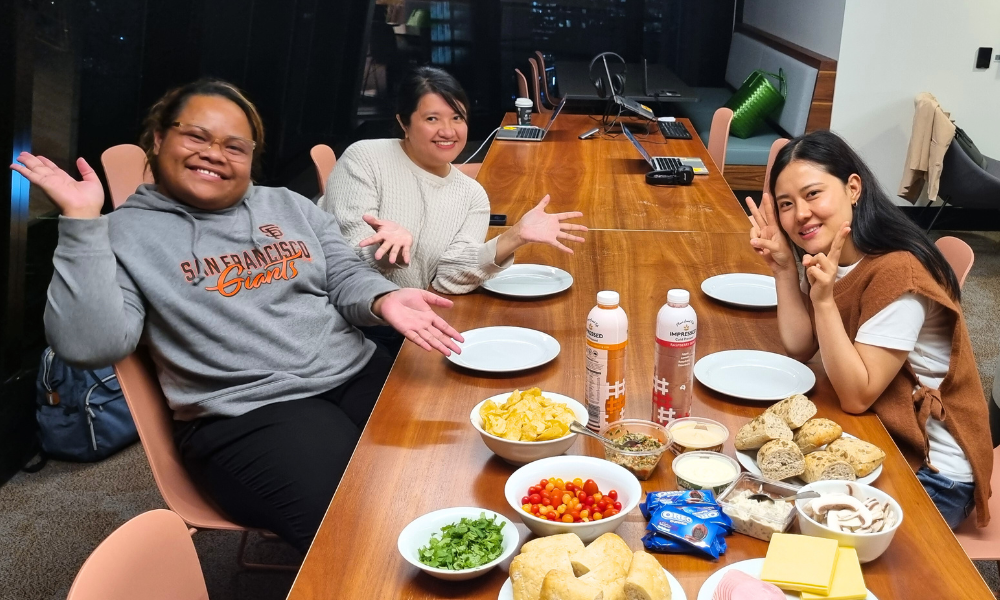
Pictured: Elisapeta Agnes Anitelea, Kesang Thrinlek, and Tshering Denka
Leave a Reply