Dr Muhammad Aziz Rahman, Professor of Public Health
Health and wellbeing are determined by many sociocultural factors aside from the structure of the health system and available resources.
In developed countries like Australia, it can be less obvious how factors such as religion, gender, and socioeconomic status impact health, as compared to developing nations.
Yet it is vitally important for Australia’s future health professionals to understand the social and cultural determinants of health and wellbeing.
At Federation University Australia (FedUni), Australian undergraduate nursing students have the opportunity to gain real-world exposure to health promotion, through the Public Health Study Abroad Program.
In January 2024, the program was hosted in Indonesia for its second year.
The program aims to assist students in understanding public health at the individual and community level, not only as it relates to health care, but also to health seeking behaviour, social determinants, risk factors, and cultural context.
This year’s program was designed to enable Australian students to interact with health care providers, patients, and community members at primary and tertiary settings in Indonesia; exposing them to public health challenges in developing countries and regional areas.
I led the program of 16 students, accompanied by two colleagues from FedUni, Dr. Biswajit Banik (Senior Lecturer of Public Health) and Ms. Nicole Coombs (Lecturer of Nursing). We were hosted locally by Universitas Airlangga (UnAir); a valuable partner of FedUni for many years.
We were welcomed by the UnAir team on the first day through an introduction to the university, a tour across three campuses, and an extensive discussion with the Faculty of Public Health.
There was a welcome reception and special dinner invitation from the Australian Consulate General in Surabaya, which the teams from both FedUni and UnAir attended.
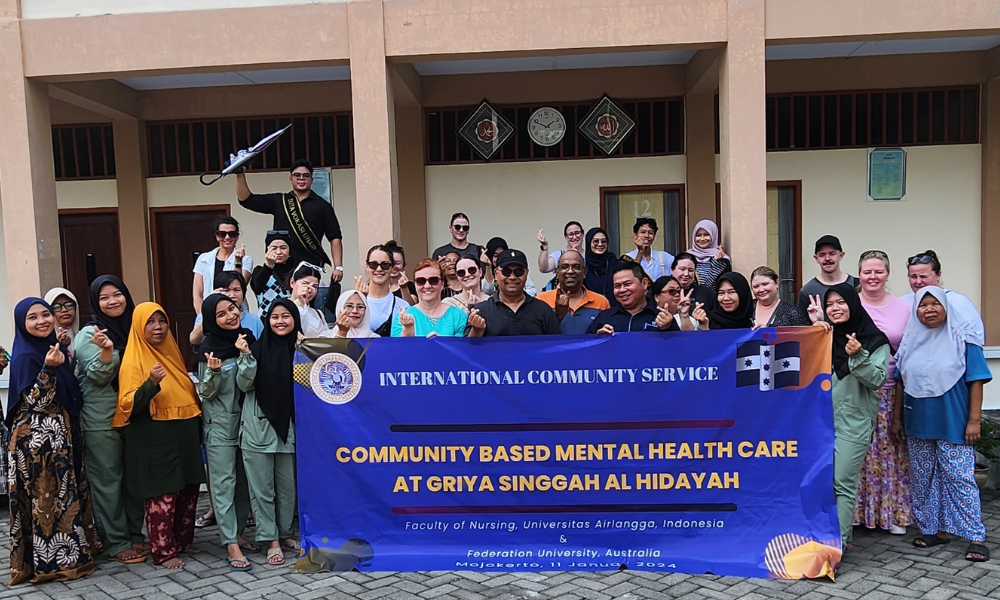
Throughout the study abroad program, we visited primary healthcare centres and one district health service office, a public and a private tertiary care hospital, an Islamic Boarding School, and a community mental health nursing home.
Students had the opportunity to interact with health care providers and senior public health professionals, patients, and community members.
Students also visited a popular radio station, Suara Surabaya, where they learnt about the role of media and communication in improving awareness about health and wellbeing.
We were accompanied by a team of UnAir students throughout all field activities, who worked as interpreters and cultural brokers. This provided an important opportunity for cultural exchange and connection between the two student cohorts.

Pictured: FedUni and UnAir students and staff at the Suara Surabaya radio station.
Traditional medicine and massage play an important role in disease management for many Indonesians.
The team were invited to learn the techniques of Javanese massage and taught how to prepare a traditional drink called Jamu – which are both common remedies for a range of ailments.
Faculty members and students from UnAir worked with us to share their traditional medicine in a fun-filled environment.
At the end of the program, students had the opportunity to reflect on and share their experiences. Students were divided into three groups which focused on one of the three important selected determinants of health and wellbeing: religion, gender, and socioeconomic status.
Each group reflected on those determinants based on their field experience and delivered a presentation in the form of a debate, where students shared arguments in favour of each determinant and the other groups countered them.
Though the reflections, the students demonstrated their improved understanding of the cultural determinants of health.
On the final day of the program, there were guest lectures from three faculty members of FedUni.
I presented on “Tobacco control challenge: Tactics of tobacco industries”, Dr Banik presented on “Demand and supply-side factors of the Australian rural men’s mental health: A scoping review”, and Ms Coombs presented on “Public health messaging by emergency nurses during disasters in Australia”.
The FedUni team also learnt a traditional Indonesian dance from the UnAir team on our final day, which further strengthened the bonds between our two universities.
Finally, each FedUni student presented a toy kangaroo as a symbol of friendship to the volunteer UnAir students.
The program was valuable for the future health professionals, who gained an enriched understanding of how sociocultural factors affect health and wellbeing at the individual and community level, and a greater appreciation of global public health contexts.
We look forward to future iterations of the program, which will continue to succeed in preparing Australian health professionals for diverse, global careers.
Professor Santi Martini, Dean of Faculty of Public Health at UnAir, was the local lead and Ms. Zida Husnina from the UnAir Faculty of Public Health, was the local Program Coordinator.
Faculty of Nursing, Faculty of Vocational Studies and World University Association for Community Development (WUACD) partnered with Faculty of Public Health to support this program in 2024.
I, along with Dr Banik and Ms Coombs, thank the UnAir team for supporting this program for the subsequent second year. FedUni students are also sincerely grateful for the opportunity to learn from the diverse health care settings in Indonesia.
Professor Muhammed Aziz Rahman, MBBS, MPH, CertGTC, GCHECTL, PhD, is a Research Adviser and Discipline Leader of Public Health at the Institute of Health and Wellbeing at FedUni, a Board Member and the Convenor of PHAA’s Health Promotion Special Interest Group, and Board Director at the Council of Academic Public Health Institutions Australasia (CAPHIA).
Leave a Reply