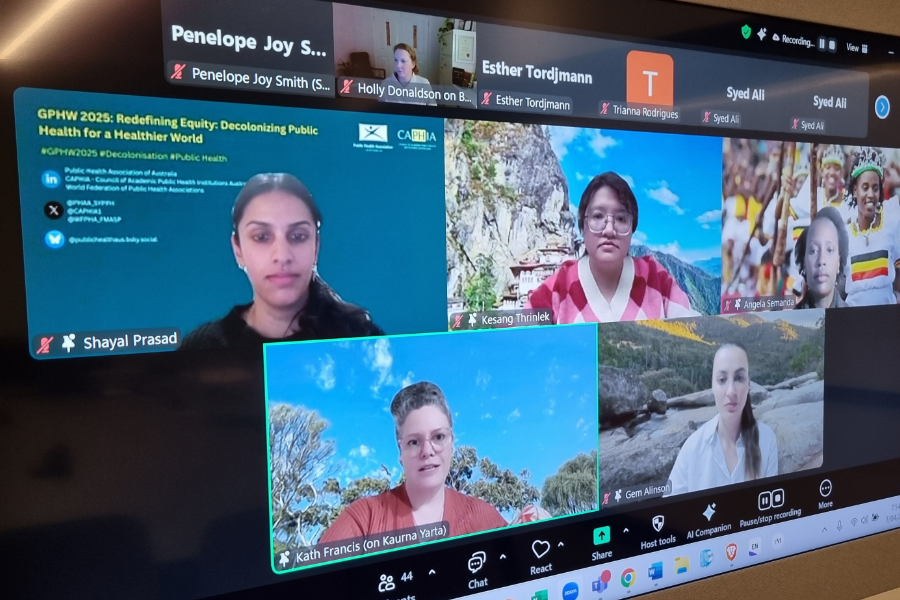
Shayal Prasad and Penelope Smith with Gem Allinson, Holly Donaldson, Dr Kath Francis, Isabelle Haklar, Angela Semanda, and Kesang Thrinlek
In the following piece, we use the terms First Nation Australians, Indigenous People and Aboriginal and Torres Strait Islander as per the PHAA Aboriginal and Torres Strait Islander Guide to terminology. When Indigenous People is used this refers to the global community of Indigenous People.
Curriculum, whether in public health or not, tends to be something that happens to higher education students in Australia. Students can give feedback at the end of a unit, subject, course or degree, and sometimes after a class or workshop, but that doesn’t typically create changes for the student in real time. This feedback is often oriented much more towards the academic educator’s skills (and likability). Often, students graduate and begin their professional careers without a chance to truly contribute to the creation and development of curriculum.
Public health competencies for Australia are currently being significantly revised. As part of this, there is consideration for new competencies, including decolonisation. Inspired by this, and for shared interests, the Students and Young Professionals in Public Health (SYPPH) committee of Public Health Association of Australia (PHAA) united with Council of Academic Public Health Institutions Australasia (CAPHIA) to hold a webinar in April. It was part of the World Federation of Public Health Associations’ Global Public Health Week, which this year had the theme Redefining Equity: Decolonizing Public Health for a Healthier World. This allowed a way for student and graduate perspectives to be included in public health teaching and learning in Australia.
The webinar organisers wanted to elevate voices often not heard in the Australian public health teaching and learning circles: international students who aren’t citizens. Driven not just by a personal and professional desire, this student group makes up a significant part of Australia’s current and recent Master of Public Health (MPH) graduates. Particularly those from countries which have experienced colonisation and imperialism, similar but different to Australia. We were also keen to have representation from our membership body, particularly someone with Australian and overseas experience. The panel members, two people of colour and one dual UK-Australian citizen, were all women and brought a particular lens to the event.
It was significant for us that this webinar on the first day of GPHW was well attended by 81 participants. It spoke to the interest within the PHAA and CAPHIA membership and beyond. Two panel members, Kesang Thrinlek and Katherine Francis, were part of the WFPHA Indigenous Working Group’s 2024 webinars on decolonisation and linked to this important global work. Katherine, an academic and CAPHIA board member on a cultural journey to find her family’s Aboriginal connections, set the scene with the World Federation’s draft definition of decolonisation and public health in her opening statements.
The panellists shared their experiences, highlighting the need for systemic changes and respectful engagement with First Nation Australian communities and global Indigenous communities. Angela Semanda discussed her journey from a biomedical model profession of pharmacy to public health, and emphasised the role of allies to First Nation Australians and Indigenous people worldwide. She actively participates by joining interest groups, attending meetings and volunteering for Australian First Nations and Culturally and Linguistically Diverse community and workplace-based groups.
Kesang shared insights from her transition from practising dentistry in Bhutan—where the biomedical model predominated—to studying public health in Australia, where she was introduced to key topics such as the determinants of health and systems thinking. During a systems thinking unit in her MPH, she encountered the concept of decolonisation through the stories and experiences of Australian First Nations communities. This prompted her to reflect on her own position as a woman of colour on a postgraduate study visa. Kesang emphasised the importance of embedding decolonisation throughout the curriculum, and critically examining who holds power in health systems.
“Decolonisation of public health should be inclusive, culturally grounded and led by communities” – Kesang Thrinlek
Gem Allinson reflected on her MPH experience and the role of decolonisation in her current profession. The concept of decolonisation was interwoven throughout her MPH, broadening her understanding of health equity and justice. She noted that it was continuously reinforced in both her university curriculum and assessment of the role of critical reflexivity to enable important changes in the self including recognition of privileged lived experience. These learnings have taught Gem to continue to actively listen and educate herself, to drive change and amplify the voices of others. Beyond this, Gem emphasised that decolonisation requires commitment from everyone – not just culturally diverse communities.
The overall discussion underscored the critical need for decolonising public health to address historical and systemic inequalities and promote health equity.
During the Q&A session, panellists discussed:
- how colonisation shaped, and continues to influence, all the determinants of health, both in Australia and globally
- challenges and opportunities to gaining in Indigenous health as a non-Indigenous person in Australia and,
- decolonising research practices and the importance of local priorities and ethics.
While Global Public Health Week 2025 is over, the conversation continues, particularly as the competencies review and revision discussions build and expand. Alongside this, the PHAA First Nations Collective work is progressing. PHAA is a powerful force in public health policy. As PHAA members, many of us recent graduates from postgraduate Public Health, we are excited to see what is possible when we use our voices to advocate for change, both as individuals and within our organisations.
For all other webinars and events that were part of GPHW 2025 please visit WFPHA website. These are highlights:
- Decolonising public health in Africa and the Tropics
- Decolonising public health Globally: Progress and Possibilities
- From Colonial Past to Community Power: Transforming Global Oral Health
Shayal Prasad is the Early Career Representative/Chair of the PHAA SYPPH Committee. She works as a Project Officer at the National Centre for Immunisation Research and Surveillance. She lives and works on Darug Country in Sydney.
Penelope Smith is PhD Candidate with the University of Tasmania undertaking her research on the land of the Yorta Yorta Nation in North East Victoria.
Gem Allinson is a policy officer with the Department of Health, Disability and Ageing, and a volunteer with the SYPPH committee (PHAA). She lives and works on Ngunnawal/Ngambri Country, Canberra.
Holly Donaldson is Executive Director, Council of Academic Public Health Institutions Australasia. Holly lives and works on land of the Bunurong people of the Kulin Nation in Naarm, Melbourne.
Kath Francis, gratefully living on Kaurna Yarta, Adelaide, is a senior academic leader in facilitating decolonising higher education systems and practices. Kath is also working to restore personal impacts of colonisation through her journey to find her family’s Aboriginal connections.
Isabelle Haklar is a Senior Project Officer at the South Australian Health and Medical Research Institute, and volunteer with the
PHAA SYPPH committee. She lives and works on Kaurna Country, Adelaide.
Kesang Thrinlek is a recent graduate of Master of Global Public Health from Victoria University, who brings more than six years of clinical experience as a dental surgeon in Bhutan’s government health system. She is also a volunteer with the PHAA SYPHH Committee. Kesang lives on Wurundjeri Woi Wurrung land (Naarm), Melbourne.
Angela Semanda is a Graduate Project Officer at SA Health, within the Commissioning, Planning, and Performance division. She previously worked as a retail and then regulatory pharmacist in East Africa, but is enjoying working upstream as a public health professional on Kaurna Country, Adelaide.
Leave a Reply