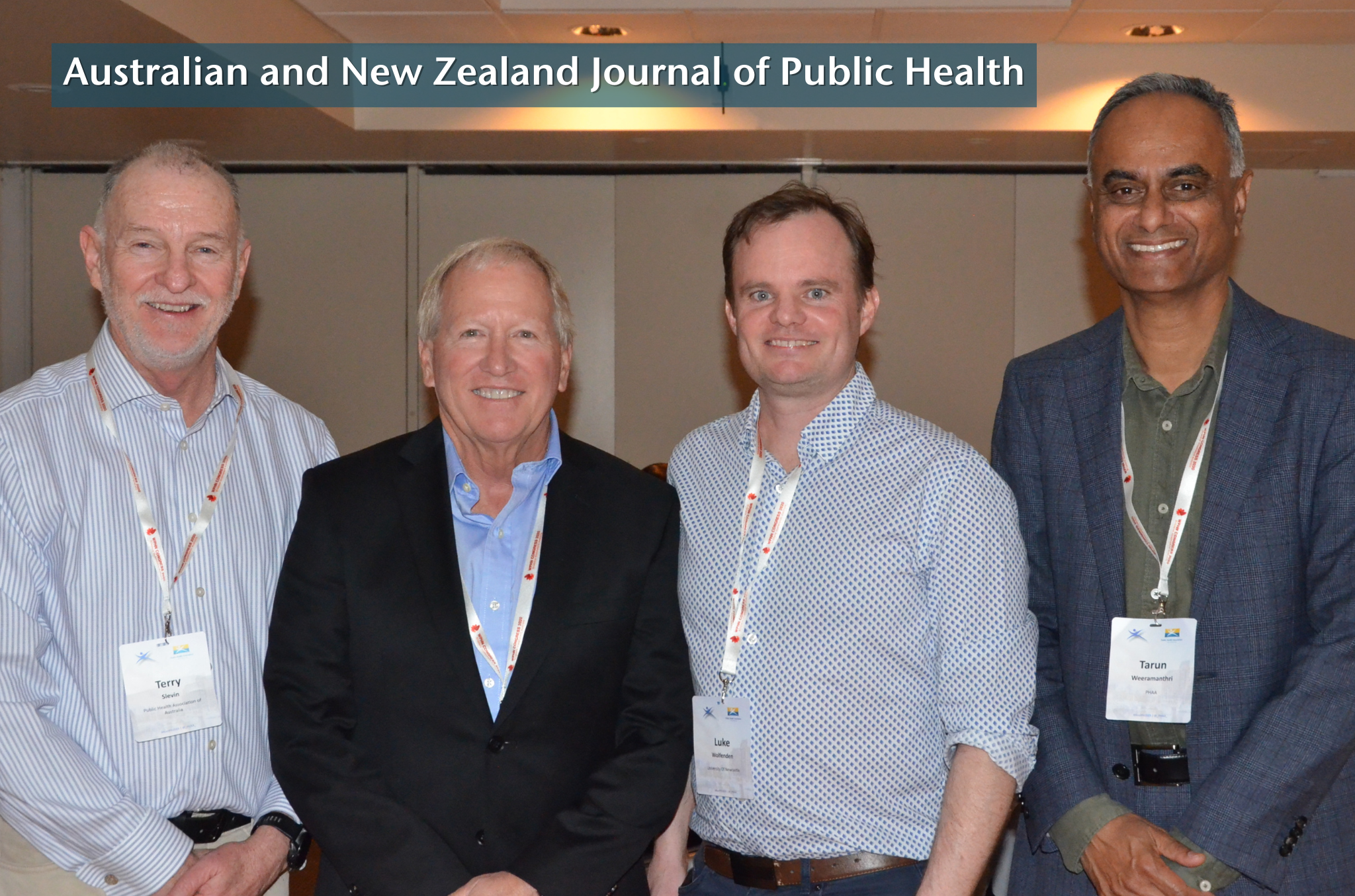
Professor Luke Wolfenden (pictured above, centre right) began his appointment as Editor-in-Chief of the Australian and New Zealand Journal of Public Health (ANZJPH) on 1 July.
We sat down with him to find out more about his career to date and vision for the Journal.
Tell us a bit about your public health career, how did you end up working in the field?
My father was a Director of Health Promotion on the Mid-North Coast, so I was always familiar with public health.
However, when it was time to go to University, I was unsure what career I wanted to pursue.
I ended up studying psychology but enjoyed public health subjects.
I went on to work in the local population health unit at Hunter New England District Health, under Professor John Wiggers and did a PhD, focusing on smoking cessation.
I then had a stint overseas at the Cochrane Collaboration in Oxford, before I returned to the local health unit.
What do you focus on in your current role?
I’m currently a Professor of Public Health at the University of Newcastle. It’s a research-only role through a National Health and Medical Research Centre investigator grant.
I also hold an appointment at the local population health unit, where I’m responsible for child health promotion services.
My role spans program development, implementation, and evaluation across child health issues such as healthy eating, physical activity, drugs, alcohol and vaping.
My roles are closely linked – my research focuses on how we can improve child health, and my practical work puts the best evidence into practice.
What inspired you to apply to be Editor-in-Chief of ANZJPH?
My dual role as both an academic and practitioner has provided me with a unique appreciation of how good quality evidence can make an impact on public health.
I also have experience editing journals. My first experience of academic publishing was as an editor with ANZJPH from 2015 – 18. It was a formative experience that set me on this path.
More recently, I was co-ordinating editor at Cochrane Public Health.
Cochrane has close ties with the World Health Organization and I gained an appreciation of how good quality research can be translated into policy and practice.
ANZJPH is a critical public health journal in this part of the world, and I feel very privileged to be offered this role and to be serving the Public Health Association of Australia, as well as the public health community more broadly.
What are the current biggest challenges in academic publishing?
Journals like ANZJPH are so important at a time when scholarly research is under threat.
Good quality peer review and good scientific processes are being undermined by the proliferation of predatory journals who don’t prioritise quality peer review.
This compromises the scientific process and makes it harder for policy makers, practitioners, and Governments to know what information to rely on.
We need trusted, peer-reviewed sources of evidence to maintain the integrity of science and inform public health decision making.
ANZJPH has a long legacy. What elements of the Journal would you like to retain, and what will you change?
I think outgoing editor Prof John Lowe has done a fantastic job.
I’ve particularly been impressed over the years with the journal’s commitment to Aboriginal, Torres Strait Islander and Māori health research. I would like to retain and build on this focus.
My broad vision is that the journal should be not just a mechanism to share research, but also a tool for public health improvement.
I will be looking for research that addresses an evidence gap, helps inform scholarly debate and could ultimately lead to policy or practice change.
What public health topics are underrepresented in journals?
I’m interested in seeing more equity focused public health research, translational research that provides evidence about how programs can be scaled up, as well as applied intervention research.
I’m hoping we will more solution focused research, rather than just describing the problem.
I’m also passionate about technology-based solutions to public health problems.
What advice would you have for researchers looking to submit to Journals?
One of the more frustrating things I see is submissions that don’t adhere to journal guidelines – for instance, articles that excessively exceed the world count or submit in categories not accepted by the journal.
I’d also recommend you demonstrate what the evidence gap your research addresses, and make sure you clearly articulate the impact and implication of the findings for further research, health, policy or practice.
Do you have any advice for early career researchers?
Find a good mentor – an experienced researcher to support you in your project.
Also, seek peer review from a colleague, friend or mentor before submitting to a journal (so that you get some appraisal before it goes to external peer review!)
And finally, what do you like to do in your spare time outside of your public health work?
Our family has a new Golden Retriever, who is keeping us very physically active!
When I’m not walking our dog, you’ll find me hanging out with my family and friends, watching live sport, and eating good food.
Editor’s note: PHAA enthusiastically welcomes Prof Luke Wolfenden to ANZJPH, and thanks outgoing editor, Prof John Lowe, for all he’s done for the Journal and wider association.
The Australian and New Zealand Journal of Public Health is a peer reviewed, multidisciplinary, open access journal produced by the Public Health Association of Australia (PHAA).
Pictured (L to R): PHAA CEO, Adjunct Professor Terry Slevin; outgoing Editor-in-Chief, Professor John Lowe; Professor Luke Wolfenden; PHAA President, Tarun Weeramanthri.
Leave a Reply