
PHAA Communications
Commerce, economy, and trade directly touch on many aspects of public health and its regulation, and structure the broader socioeconomic conditions that shape human health and health equity.
The upcoming PHAA and VicHealth Commerce, Economy, Trade and Public Health Conference will explore the complex relationship between these factors, and ways to improve global policy to equitably protect health.
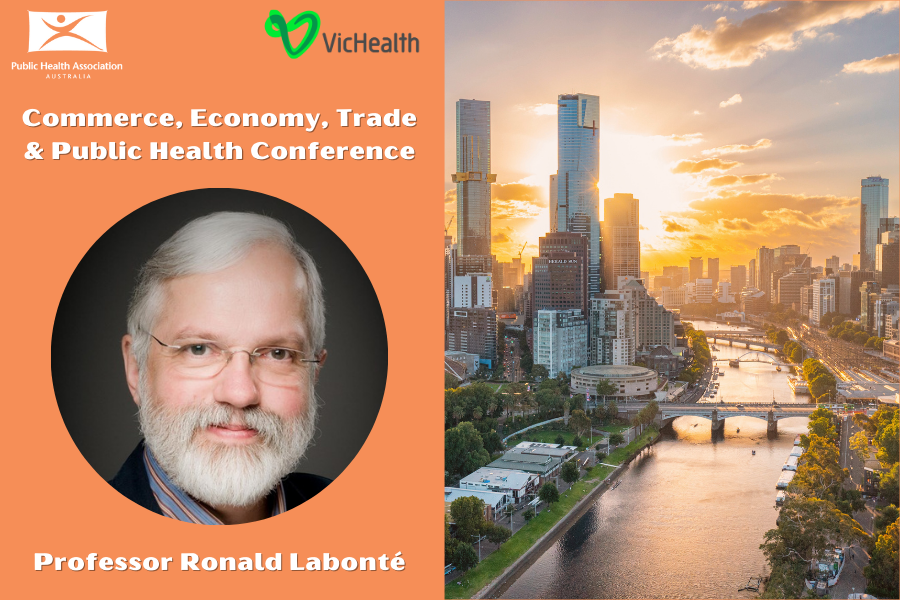
Dr Ronald Labonté, Professor Emeritus and former Distinguished Research Chair in Globalisation and Health Equity at the University of Ottawa, will be presenting at CETPH on public health’s role in commercial and economic systems.
Dr Labonté recently shared with us insights from his 50-year career – including his criticisms of our ‘destructive system of capital accumulation’, and why public health can no longer fence-sit politically.
What’s been your career trajectory to date?
I started working as a health promoter in the early 1970s, bringing to my work a concern with equity and justice.
Active in many social movements of the time, I brought their critiques and political claims to my work, sometimes getting into trouble for it!
As I pursued graduate training while working for governments, my focus shifted more to university, and eventually I became a professorial research chair. My critical concern with equity only deepened.
What sparked your interest in globalisation and health equity?
Most of my early health promotion work involved prodding public health to become a more empowering and socially activist partner with community groups.
Much of this work involved issues that have since been labelled the ‘social determinants of health.’
I began consulting internationally on some activist models I had developed, and in country after country, I heard complaints of fiscal retrenchment (budget crisis measures), austerity, and privatisation.
I figured there must be something going on at the global level that was pushing nation states in this neoliberal direction.
My attention shifted to the global scale of health and international policy. That was in 1993, and in 1994 the World Trade Organization was birthed. Unsurprisingly, then, trade became my first big global health issue to tackle.
By 1999, I was ensconced in universities and so began 25 years of researching globalisation as a social determinant of health.
What are you working on now?
I retired from active research two years ago, tired of chasing grant funding and having run the gamut of globalisation and health related topics.
I spent a year writing up some of what my research work had taught me, which was published in 2019 by Oxford University Press as Health Equity in a Globalizing Era.
I became more interested in harnessing my analyses to direct political action through the People’s Health Movement (PHM).
PHM is turning 25 next year, and is an international network of academic, civil society, and grassroots activists deeply engaged in efforts to tackle our worsening multi-pronged crisis (or ‘polycrisis’) of wealth inequalities, climate chaos, and the rise in xenophobia.
My PHM work has primarily been contributions to and co-editing of its periodic book, Global Health Watch. Edition seven is expected in mid-2025. I’m also one of the chief editors of the BMC journal, Globalization and Health. That, and two grandnephews, keeps me busy!
What would you like conference delegates to gain from your presentation about public health’s role in commercial and economic systems?
Firstly, an appreciation for how capitalism functions as the underlying generator of our polycrisis, as things continue to spiral worse.
There are hints of progressive reforms: people are increasingly recognising the incompatibility of our consumption-centric and patriarchal, capitalist society with human health and survival.
The political risks of advocating for these reforms are significant and will challenge all public health practitioners – especially reforms sufficiently radical to move us out of our unequal and destructive system of capital accumulation.
But as I wrote in a recent editorial in a Canadian public health journal, ‘public health can no longer fence-sit politically.’
Like our historic inspirer, Rudolf Virchow, we need to join with those activists prepared to put themselves in harm’s way for the sake of our collective health and wellbeing.
Was there anything else you wished to add?
We are at a moment when our attention to self-care and other care is probably more critical than at any other time in our lives.
We need to embrace the risk of activism and change, but in a way that channels our optimism, and that invokes Emma Goldman’s oft-stated aphorism (even if a trifle incorrectly): ‘If I can’t dance, then it’s not my revolution…’
To which I must add: are there any dances planned for the conference?
There’s still time to register for the Commerce, Economy, Trade and Public Health Conference, to be held in Naarm/Melbourne on 18-19 November.
See the full line-up of speakers and register now.
Image: Prof Ronald Labonté (supplied) / Melbourne city skyline
Leave a Reply