
Deena Mehjabeen
The Preventive Mental Health Conference 2026, co-hosted by the Public Health Association of Australia (PHAA) and Prevention United, provided a valuable opportunity to reflect on the future of mental health promotion in Australia.
Held on Dharug Country, Parramatta, on 24–25 March, it brought together voices from research, policy, and practice to explore how systems can better support population mental health.
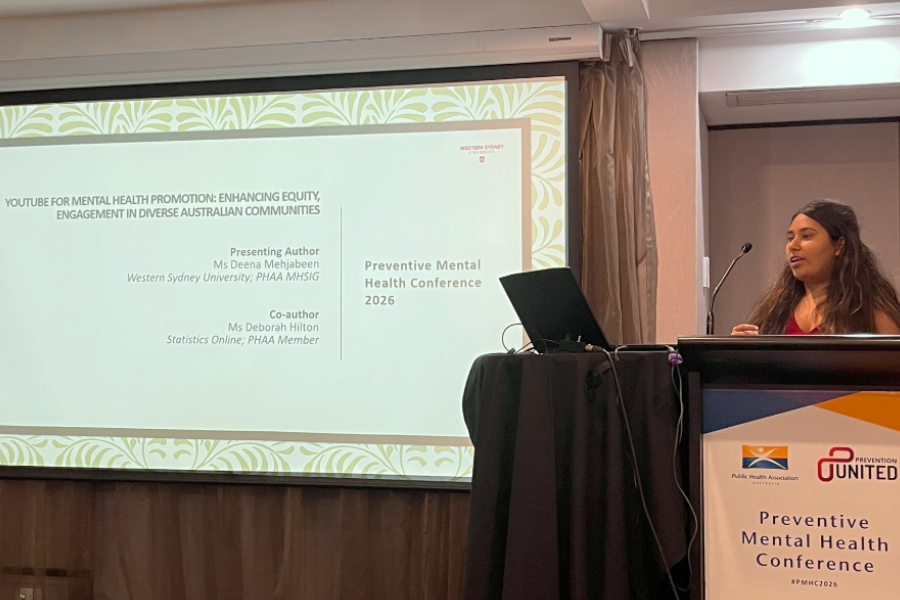
I was grateful to attend as a conference scholarship recipient. I also had the opportunity to present collaborative work with a fellow PHAA member on using YouTube as a platform for mental health promotion to enhance equity and engagement among diverse Australian communities.
This aligned closely with broader conversations across the conference on how digital approaches can extend reach and support populations who may not be consistently reached by existing services.
Across panels and discussions, a consistent message emerged: the need to shift from crisis-driven responses towards sustained investment in prevention and early intervention. While this is not a new direction, the conference reinforced the urgency of moving beyond endorsement towards implementation across systems. One of the most compelling themes was the role of everyday actions and community-based approaches in supporting mental health.
Presentations such as the ‘Big 5 Framework’ highlighted how simple, evidence-informed activities can support wellbeing at a population level. The five are:
- engaging in meaningful activities,
- practising healthy thinking,
- setting goals and plans,
- maintaining healthy routines, and
- staying socially connected.
Community-led initiatives, including ‘Old School Night Out’, the ‘Grit and Resilience Festival’, and dance-based programs for older adults, demonstrated how connection, creativity, and participation can reduce loneliness and strengthen mental health in meaningful and accessible ways.
What stood out for me was the consistency of these approaches in placing people, connection, and participation at the centre, reinforcing that prevention is embedded in the social environments in which people live, rather than limited to formal services.
Alongside this, there was strong emphasis on addressing the social determinants of mental health, including housing, employment, and social inclusion. Without tackling these structural factors, efforts to improve mental health outcomes will remain limited. There was also clear recognition that effective mental health promotion must be culturally responsive and grounded in community knowledge. First Nations leadership and knowledge systems were consistently highlighted as essential to shaping holistic and place-based approaches, alongside the importance of culturally responsive mental health promotion for diverse communities.
Discussions on equity were further deepened through workshops focused on youth mental health initiatives and co-design approaches, which emphasised the value of engaging young people directly in the development of services and programs. These sessions reinforced the importance of ensuring that mental health responses are culturally safe and accessible, and shaped by the communities they aim to support.
The conference also reinforced the value of cross-sector collaboration, with contributions from health, education, and community sectors demonstrating the importance of integrated approaches. For me, a particularly meaningful aspect of the conference was the opportunity to connect in person with members of the PHAA Mental Health Special Interest Group (SIG), a group I have been involved with since 2021.

I also had the opportunity to contribute to the PHAA Mental Health SIG booth, engaging with attendees and sharing information about the SIG’s work and membership. These interactions highlighted the importance of professional networks in strengthening collaboration, supporting knowledge exchange, and building collective momentum in public health. Informal networking opportunities throughout the conference further supported these connections across sectors.
Overall, the conference highlighted that while there is strong consensus on the importance of prevention, equity, and integration, translating these priorities into practice remains an ongoing challenge. Strengthening national leadership by governments and peak bodies, embedding prevention across sectors such as health, education and community organisations, and supporting culturally responsive and community-led approaches will be critical to achieving meaningful and sustained change. For researchers and practitioners alike, the challenge is not only to generate evidence but to ensure it is applied in ways that are accessible, inclusive, and responsive to community needs. Conferences such as this play an important role in bridging research, policy, and practice, and in fostering the connections needed to support more effective and equitable mental health systems.
Deena Mehjabeen, a Co-Convenor of the PHAA Mental Health Special Interest Group, is an early-career public health researcher specialising in culturally informed mental health and self-care for refugee and migrant communities.
Leave a Reply