Matilda Houlihan, Kylie Maidment, Stephen Carbone, Lachlan Kent, Thea Orr, and members of the Prevention United Youth Advisory Group (YAG) – Alannah Sander, Chuan Huang Hii, Emily Howells, Isaac Yau, Jasmine Toronis, Katherine Georghiou, Lauren Jackson, Sumeyye Nur Gungor, Wesley Chen, and Zinzan Hunt-Rosacker
Prevention United today released the results of a recent survey of youth mental health in Australia. Find it here.
Official data has shown a steep increase in depression and anxiety in young Australians. There is no single cause attributed to this. Rather, research has found a range of factors affecting young people and contributing to the decline in their mental health.
The youth mental health “crisis” has had considerable media attention in Australia, but few holistic solutions proposed. Current approaches have an almost exclusive focus on services and treatment initiatives. On their own, these are likely to be insufficient to address the decline in young people’s mental health and wellbeing.
To create meaningful change, we must include the voices of young people in the development of policies that affect them. We must recognise their stressors and what promotes their wellbeing.
Only then can we understand how to help young people and halt the decline in their mental health.
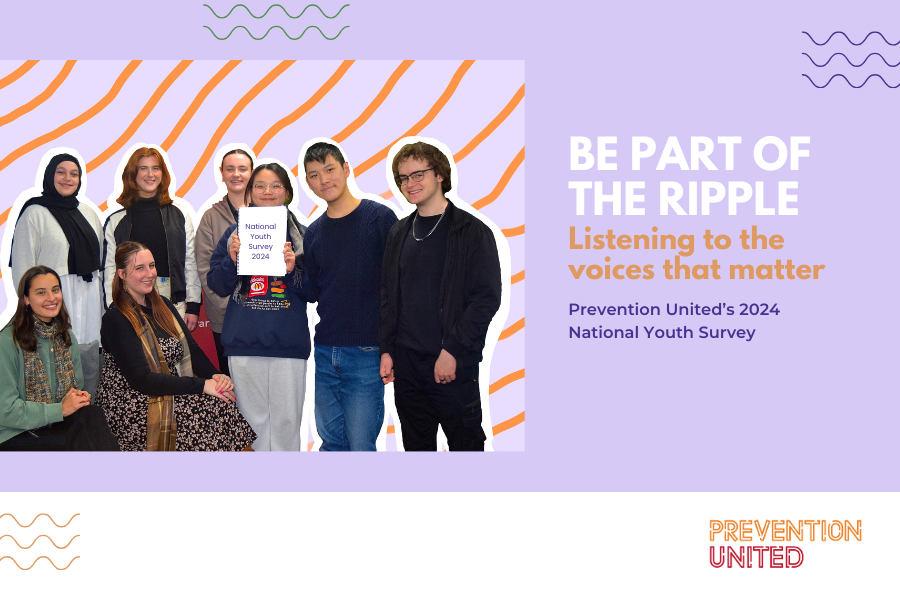
The 2024 Prevention United Youth Advisory Group (YAG) was formed by Prevention United to advise and inform our policy and advocacy work in mental health promotion and preventative mental health. The group comprises 10 young people aged 16-21 years.
Members of the YAG expressed frustration with dominant narratives – that young people lacked resilience, and that the youth mental health crisis is caused by their use of social media and exposure to the online world.
So, the YAG decided to design a survey and gather insights from other young Australians around which factors positively and negatively impact their mental health, and what they feel the Government can do to help them.
The survey was conducted online. Young people aged 16-25 living in Australia were eligible to take part. 589 young people responded, with a mean age of 20 years. Most respondents (86%) disclosed that they have lived or living experience of a mental health condition.
Young people were clear about the negative influences on their mental health. These were fears about the future; finances (cost of living); loneliness; global events (e.g., wars, conflicts, COVID-19); family relationships; and poor sleep.
Young people identified the factors that positively impact their mental health to be friendships, a good night’s sleep, music and the arts, greenspaces and nature, and family relationships.
Young people also ranked activities they typically engage in to boost their mental health.
The highest ranked activities centred around music and the arts, learning how to handle stress, developing skills to build strong relationships, learning how to support those with mental ill-health, and understanding how to manage family difficulties.
Young people were clear on the solutions that would improve their mental health. These included keeping housing and rent affordable, cost-of-living support, investment in mental health promotion and prevention initiatives, paying students on placement, and decreasing the cost of public transport.
Members of our YAG agreed with the survey results indicating that friends, a good night’s sleep, and music and the arts promoted positive mental health and wellbeing.
However, they noted that high cost of living often makes it hard to see friends in person or access music and the arts (e.g., attending live events).
Prevention United YAG member: “Fear of the future was something we thought was relevant – it is so interesting to see that other young people really agreed”.
The survey results align with similar research, including the Lancet Psychiatry Commission on youth mental health which highlighted the impact of global megatrends on young people’s economic security and hopes for the future.
These include high cost of living, insecure employment, declining social cohesion, global instability and climate change. Unstable employment, high cost of living, and financial stress have the potential to directly and indirectly affect young Australian’s mental health and wellbeing.
Similarly, a recent survey of 18–24-year-old Australians found the top three factors negatively impacting youth wellbeing were figuring out their future, burn out, and cost of living.
While other surveys tend to focus on factors associated with poor mental health, our survey provides insights into practical solutions that can be implemented to support young people. Examples include providing low-cost safe spaces for young people to meet or attend music events, and increased access to green spaces.
The survey data highlights the importance of engaging young people and amplifying their voices if we are to develop meaningful and impactful policies.
While young people ranked social media as 12th out of 20 in factors negatively impacting their mental health, it has dominated politics and media. Issues such as cost of living and future uncertainty, which were more significant to young people, have largely been ignored.
Prevention United YAG Member: “All of the funding going into social media regulation… imagine if you put that into cost of living so that people could have food on the table and pay rent – that would have a big impact”.
It is time to genuinely listen to young people’s concerns and take meaningful action to address the factors they identify as driving declines in mental health. Mental health conditions are not inevitable – we must focus on reducing risk factors and increasing protective factors to support wellbeing.
The overwhelming response to the survey was a plea to listen to youth, and for decision-makers to act on young people’s ideas, giving them the agency to generate the change they wish to see.
We hope these voices spark a ripple effect, be heard by Government, and contribute to addressing the significant challenges facing young people in Australia.
Our young people welcome questions and further conversation – get in touch via youth@preventionunited.org.au.
You can read the full report, ‘Be part of the ripple – listening to the voices that matter’ here.
Image: Supplied / (L to R, back row): Sumeyye Nur Gungor, Alannah Sander, Lauren Jackson, Chuan Huang Hii (Merry), Isaac Yau, Zinny Hunt; (L to R, front row): Jasmine Toronis, Emily Howells
Leave a Reply