Adj Assoc Prof Priscilla Robinson and Hon Assoc Prof Leanne Coombe
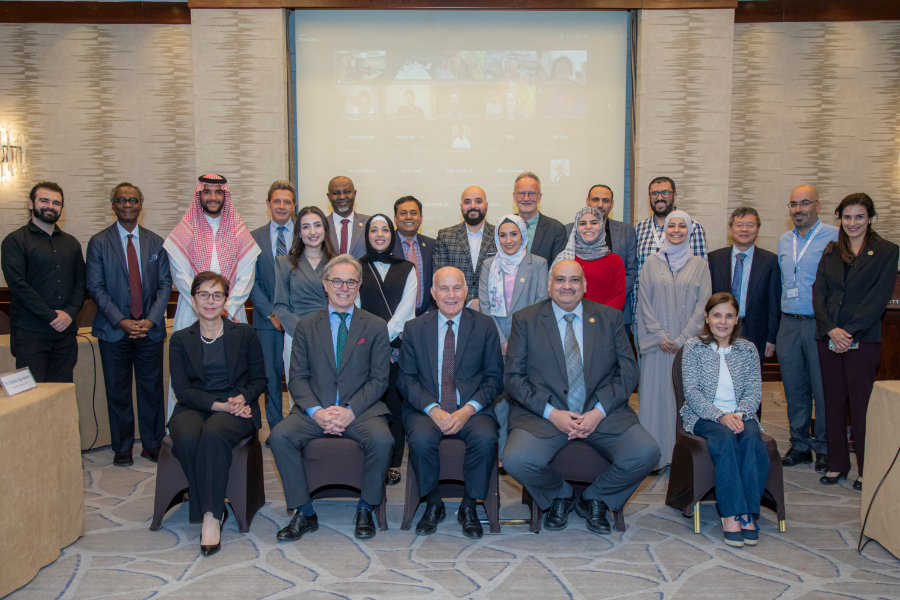
The fourth meeting of the World Health Organization Steering Committee (SC), which is overseeing the National Workforce Capacity to Deliver the Essential Public Health Functions Roadmap (the Roadmap), was held on 22-23 October 2024.
The SC meeting was hosted by the Eastern Mediterranean Public Health Network (EMPHNET) in Amman, the capital of Jordan – a country currently encircled by political disruption, which brings unique challenges to building the public health workforce.
Current human-induced and natural disasters also present important and timely reminders of the need for and purpose of the Roadmap.
Earlier this year, a suite of tools and guidelines were published in the National Workforce Capacity for Essential Public Health Functions Collection, to assist countries with national benchmarking, analysis, and coherent actions to systematically enhance their institutional capabilities and workforce competencies.
These tools consist of an overarching operational handbook, plus guidelines and methods for mapping each of the Roadmap’s action areas including the essential public health functions, competency-based education, and workforce enumeration.
The main purpose of the fourth SC meeting was for members to report on progress towards implementation of the Roadmap and identify practical ways of progressing this work in more countries around the globe.
Since the third SC in Rome, there has been substantial progress in advancing the broader public health architecture to align national health initiatives with the professionalisation and development of the global public health workforce.
Dr Tedros Adhanom Ghebreyesus, the WHO Director-General, sent a considered contribution which highlighted the importance of diplomatic efforts to secure political security and funding for public health activities.
Key WHO global partners, which include the International Association of National Public Health Institutes (IANPHI), Global Outbreak Alert and Response Network (GOARN), Global Network for Academic Public Health (GNAPH), and World Federation of Public Health Associations (WFPHA), each presented overviews of their organisational work in using and promoting the Roadmap.
Given the WFPHA has over 130 member organisations and represents more than five million public health practitioners, the WHO workforce team are keen to engage with the WFPHA in its rollout of the Roadmap. PHAA is an organisational member of the WFPHA.
As co-chairs of the WFPHA Professional Education and Training Working Group, we have the privilege of representing the WFPHA on the SC and play significant leadership roles in the Roadmap activities.
We each co-chair, alongside colleagues from GNAPH, separate working groups that provide technical advice and have been instrumental in the design, and implementation of the Global competency and outcomes framework for the essential public health functions.
As representatives of the WFPHA, we reported on our full schedule of promotional activities including webinars, recorded interviews, blogs, conference presentations and posters, peer-reviewed papers, and competency revision consultations, for the most part conducted through the Professional Education and Training Working Group.
We also reported on the work of the subgroup that has been formed to implement the competency-based education framework. The membership of this group consists of global organisations involved in the accreditation of education and training programs, and the credentialling and regulation of practitioners, in their respective subdisciplines of public health.
During the meeting, members were also presented with various case studies from a diverse range of countries on benchmarking activities being undertaken, covering all three action areas. Country case studies included Australia, Azerbaijan, China, Colombia, India, Jordan, Kenya, Papua New Guinea, Saudi Arabia, South Africa, United Kingdom, and Zimbabwe.
Most presentations highlighted work involving mapping of the essential public health functions against services and defining and enumerating the workforce.
Five examples of workforce capacity development were also presented, including from our neighbours in Papua New Guinea.
There was an appreciation of the need for emergency preparedness – not just resource provision in response to disaster – but a pre-trained and educated workforce available when emergencies occur.
There was also increasing recognition of the need for coordinated and accredited training that meets consistent standards globally and produces work-ready graduates.
The need for practical, experiential, and academic learning was highlighted in the discussions, alluding to the need and desire for a regulated public health workforce.
This also recognised that different jobs are done by different people with different job titles, linking back to the purpose of mapping of the workforce.
The work of the competency-based education subgroup was therefore recognised for the critical role it will play in progressing the professionalisation component of the workforce capacity building.
WFPHA and GNAPH were tasked with forming a delegation to meet with Dr Tedros Adhanom Ghebreyesus to brief him on this ongoing work and secure commitment from the WHO to progress this agenda.
As a knowledge transfer mechanism, a special edition dedicated to implementing the Roadmap that highlights lessons learned for adoption and to promote participation by other countries, is planned in the Public Health Reviews Journal.

Featured image: The WHO Public Health Workforce Roadmap Steering Committee at their fourth meeting.
Leave a Reply