Malcolm Baalman
Everyone deserves to live a long, healthy life. But new data released yesterday by the Australian Institute of Health and Welfare (AIHW) shows Australia’s governments are collectively not investing enough in keeping people safe from diseases.
Prevention is better than cure, but we’re doing barely half of what’s needed to properly prioritise the prevention of diseases and early death.
According to AIHW’s Government expenditure on public health activities in Australia 2024-25 report, only three cents in every dollar is going toward public health and prevention.
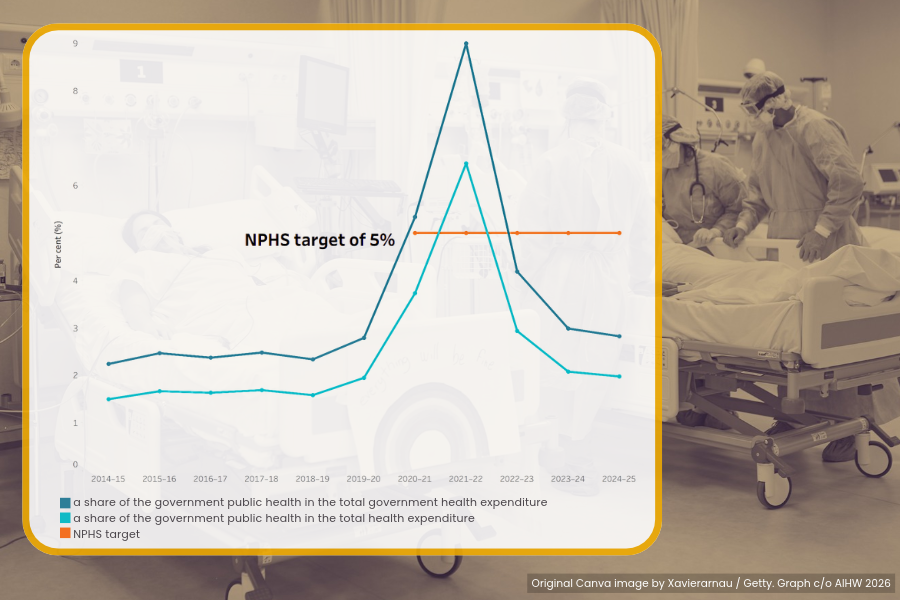
“The proportion of government public health expenditure to total government health expenditure was 2.8% in 2024–25.” – AIHW
This is concerning, because if we spend too little on prevention, we’re robbing people of potentially much healthier lives, and increasing levels of preventable diseases and early deaths. We’re also placing much higher demand pressure on a healthcare system already struggling.
To sustainably run our health systems, governments must make a more substantial contribution to preventive measures.
Aiming for 5% for prevention
Some years ago, the National Preventive Health Strategy 2021-2030 identified spending on preventive health – at around 2% of total health spending in 2018-19 – was inadequate.
The landmark Strategy set a target of 5% of health spending for preventive health across governments by 2030. Yet there’s been minimal progress toward this target, and we risk falling far short.
Latest data cause for concern
The latest AIHW statistics for public health activities include immunisation programs and infectious disease control, but also cover other important pieces of the puzzle, such as environmental health, food standards and hygiene, and much more.
Spending on immunisation and infectious disease control spiked massively during early COVID-19 years, explaining the sharp rise in the below graph.
But after investment on the pandemic abated, underlying government public health efforts are now once again well below the 5% target. The current 2.8% figure for 2024-25 is only slightly above pre-COVID-19 figures.
This isn’t rational government spending policy; failing at disease prevention means spending billions of dollars annually in health care and treatment costs which could have been avoided.
Some progress
While collectively jurisdictions are failing to make meaningful progress toward the 5% target, there are some promising signs in some areas.
The new permanent Australian Centre for Disease Control is a step in the right direction at federal level. But the agency has yet to be given the mission and funding to address non-communicable diseases.
South Australia established Preventive Health SA two years ago, indicating a renewed focus on prevention, and hopefully an indication of greater investment in preventive health to come in that state.
Western Australia has made its own specific political commitment to achieving the 5% prevention-better-than-cure target, endorsed by the past two state Premiers, Mark McGowan and Roger Cook.
Victoria and NSW have elections in the months ahead. Whether the contesting political parties will commit to keeping their residents healthy from preventable disease remains to be seen.
Not meeting the 5% target by 2030 would be a failure of health policy, leaving millions of people worse off.
Resources
- AIHW Government expenditure on public health activities in Australia 2024-25
- PHAA VIC Branch election platform
- PHAA NSW Branch Great Debate
Malcolm Baalman is manager of the Public Health Association’s Policy and Advocacy team.
The main image in this essay is based on table 5 in the AIHW Health Expenditure Database.
Leave a Reply