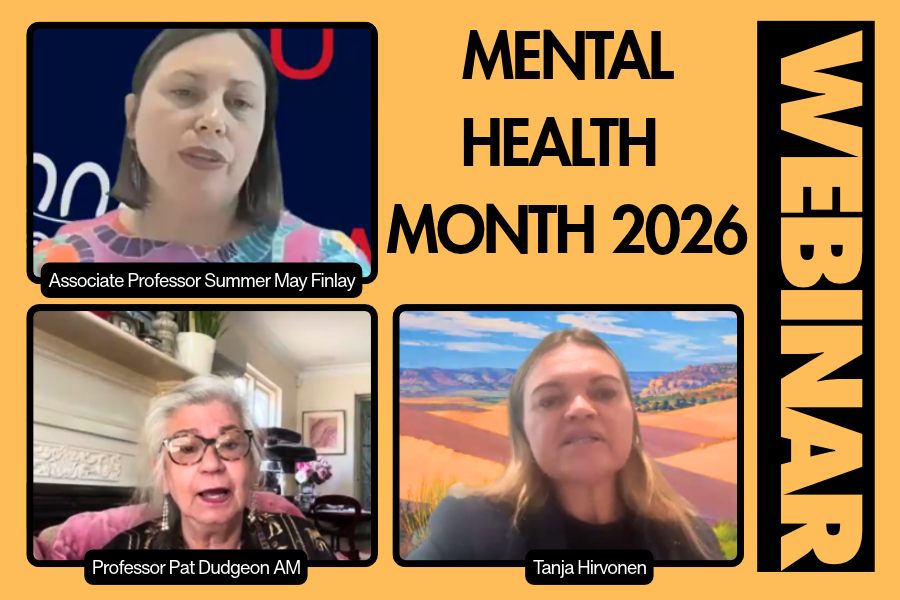
Summer May Finlay, Tanja Hirvonen, Pat Dudgeon AM, Mel Parker
First Nations leaders from across the continent have shared their mental health and wellbeing expertise during a special webinar to mark Mental Health Month.
The gathering on 20 October was co-hosted by the Public Health Association’s First Nations Collective – a body whose voices help guide the association’s operations – and the association’s Mental Health Special Interest Group.
It featured proud Bardi woman Professor Pat Dudgeon AM, Director of the Centre of Best Practice in Aboriginal and Torres Strait Islander Suicide Prevention at the University of Western Australia. Alongside her was proud Jaru and Bunuba woman Tanja Hirvonen, Chief Executive Officer of Thirrili, an Aboriginal and Torres Strait Islander Community Controlled Organisation that provides suicide postvention services. To the Bunuba, Thirrili means thrive and strength.
The webinar was facilitated by proud Yorta Yorta woman Associate Professor Summer May Finlay, a University of Wollongong-based scholar who is PHAA Vice President (Aboriginal and Torres Strait Islander) and the Collective’s co-chair. [Essay co-author Mel Parker is PHAA’s Policy and Advocacy Officer].
Assoc Prof Finlay started by highlighting how the PHAA Mental Health SIG and First Nations Collective thought Mental Health Month was an ideal time to shine a light on Aboriginal and Torres Strait Islander suicide prevention.
Suicide prevention is important to reduce the increasing suicide rates in some Aboriginal and Torres Strait Islander communities.
It’s crucial to hear from Aboriginal and Torres Strait Islander people working in the space, to enable other people in public health to consider what they can do to be part of the solution.
Changing the narrative
Speakers first reflected on their careers and background, with Prof Dudgeon sharing how she was one of the first Indigenous psychologists to graduate in Australia. She noted how “it was a bit of a journey”.
“It was a very mainstream discipline – there was no room for culturally different groups… and definitely no room for us”.
“Much of my life has been about challenging the western hegemony and creating spaces for Indigenous people and Indigenous knowledges”.
On suicide prevention in her career, Prof Dudgeon said she initially steered clear of the space due to its heartbreaking nature, but noted that, “like a lot of Aboriginal families, it came to our [family’s] doorstep as well”.
“There [are] not many Aboriginal families who [have not] had that terrible experience, … and also we count extended families as well”.
During a period of grief in her own family, she said, “I turned my attention to [suicide prevention].”
Prof Dudgeon shared how in the past, a predominant narrative around suicide was often that it was viewed as an individual’s shortcoming, with this discourse not considering the wider determinants that affect someone’s life.
Prof Dudgeon explained a large project that her and a team worked on, which sought views from Aboriginal and Torres Strait Islander communities. While communities were concerned with clinical issues, the need for self-determination and cultural solutions were the stronger messages. The Solutions That Work report’s success helped change the narrative and increased focus on considering the social and historical determinants of wellbeing among Aboriginal and Torres Strait Islander people.
She highlighted the importance of Aboriginal and Torres Strait Islander governance and empowering communities.
“We need to be able to determine what works for us and be resourced to do it”.
These principles are predominant in the National Aboriginal and Torres Strait Islander Suicide Prevention Strategy.
Tanja Hirvonen completed “a double degree in psychology and human resource management, and then ended up coming through, doing Honours and getting into the Masters in Clinical Psychology.”
Early in her career, Tanja worked in suicide prevention, then worked with those impacted by trauma and post-traumatic stress disorder in the Northern Territory, before returning back to suicide prevention and postvention as CEO of Thirrili.
Closing the Gap and empowering communities
Tanja highlighted the concerning figures in the Closing the Gap data for target 14 – which focuses on reducing suicide levels toward zero among Aboriginal and Torres Strait Islander people. She stressed the need for substantial investment and support to reach this target.
Assoc Prof Finlay added that, instead of that gap narrowing, it was widening.
Tanja discussed heightened racism and discrimination surrounding and following the Voice to Parliament Referendum in October 2023.
“I think we’ve seen racism at levels that we’ve never seen before,” said Tanja. “They’re highly alarming.”
Speakers then reflected on how to progress towards meeting target 14.
Tanja said community-led programs need investment and resourcing, as each community is different.
“The one size fits all approach doesn’t work.”
Prof Dudgeon agreed.
“We have to empower the communities, we have to support them”
“There should be a range of different culturally appropriate programs and services, including clinical services available for any… Aboriginal and Torres Strait Islander person at any time, and [our people] should be able to access those different programs.”
In addition, as Aboriginal and Torres Strait Islander people also use mainstream services, Prof Dudgeon emphasised: “We have to still make sure mainstream services… are culturally responsive.”
She also highlighted the need for system changes and noted that this is not a small thing to do.
“Governments, even though they might mean well, it’s hard for them to think outside the square.”
What can public health practitioners do?
In response to a question from A/Prof Finlay on what public health professionals can do, Prof Dudgeon advised:
- Become familiar with programs like R U OK?
- Check in with people that you might have concerns about
- In general, particularly if you’re non-Indigenous, I’d be learning about the history and culture of Aboriginal and Torres Strait Islander people. Become culturally aware.
- Read Summer May Finlay’s very good paper on how to be a good ally
- Get to know the local history and issues
“[As professionals], we can’t hide away in our clinics or offices… we are a part of the world so get out there and learn about it!”
Tanja added to Prof Dudgeon’s advice that it is important to learn from perspectives and research that have an Aboriginal and Torres Strait Islander lens.
Following an engaging Q&A session, A/Prof Finlay summarised the webinar by highlighting, among other points, that “relationships matter in this space” and “it’s not a fly in, fly out model.”
A/Prof Finlay also emphasised that prevention is absolutely key to strengthening wellbeing.
Thank you to all who attended the webinar.
Resources
- Solutions that work: What the evidence and our people tell us: Aboriginal and Torres Strait Islander Suicide Prevention Evaluation Project Report
- Working Together: Aboriginal and Torres Strait Islander Mental Health and Wellbeing Principles and Practice, 2014
- Gayaa Dhuwi (Proud Spirit) Declaration Framework and Implementation Plan
- National Aboriginal and Torres Strait Islander Suicide Prevention Strategy
- How to be a good ally
- PHAA Mental Health Special Interest Group
Help is available
- 13YARN – an Aboriginal and Torres Strait Islander service. Call 13 92 76 or visit 13yarn.org.au
- Lifeline – Phone 13 11 14 or visit lifeline.org.au.
- Suicide Call Back Service – Phone 1300 659 467 or visit suicidecallbackservice.org.au
Leave a Reply