Kate McBride
At the 2026 NSW Great Health Debate on 1 October, there was striking agreement across the political divide that prevention must play a much greater role if NSW is to build a sustainable health system. However, the harder question is whether that consensus will translate into action before the March 2027 NSW state election.
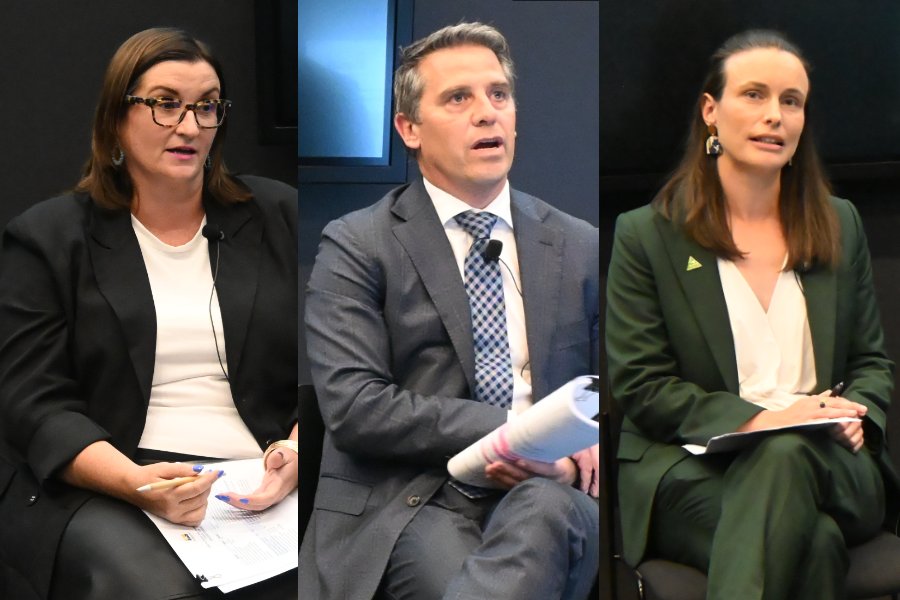
Hosted by the NSW Branch of the Public Health Association of Australia and the University of Sydney’s School of Public Health, the Great Health Debate brought together NSW Health Minister Ryan Park (pictured above, centre), shadow minister Sarah Mitchell MLC (pictured, left), and Greens health spokesperson, Dr Amanda Cohn MLC (pictured, right).
They were asked to tackle the deceptively simple question: how do we keep people healthier rather than waiting until they become sick?
The trio agreed prevention was essential, as NSW grapples with growing unsustainable pressure on hospitals, increasing rates of chronic disease, and persistent health inequities.
This agreement on not being able to treat our way out of growing demand did not extend to proposed solutions, however. The debate surfaced differences over how quickly NSW should act, how industries contributing to poor health should be regulated, and whether prevention need new structures and dedicated investment to have any impact.
The challenge, therefore, is moving from agreement on the need for prevention to meaningful action, and prioritising that in the lead-up to the 2027 NSW election.
Listen to the podcast of the debate here
What the political leaders said
Despite their political differences, the three panellists shared plenty of common ground. All recognised that NSW cannot respond to growing health demand through hospitals and acute care alone, with prevention central in creating a sustainable health system. Where they differed were the priorities they emphasised about how they believed change should occur.
Labor’s Health Minister Park firmly framed prevention as health system sustainability. Pointing to an ageing population, growing rates of chronic disease and pressure on hospitals, he argued that prevention must occur across the life course. Illicit tobacco and vaping were a particular concern, especially the risk of a new generation becoming dependent on nicotine. Park highlighted existing action on stronger tobacco licensing, enforcement, and penalties for illicit tobacco retailers being taken in parallel with harm minimisation initiatives including drug checking and festivals.
The Nationals’ Shadow Health Minister Mitchell argued for greater investment in prevention but focussed on turning existing plans into action, calling for longer term investment that extends beyond electoral cycles, and stronger coordination across government portfolios. Mitchell’s major concerns were childhood obesity, declining physical activity, and immunisation rates as well as vaccine misinformation. She repeatedly highlighted inequities in healthcare access for rural and regional communities.
Greens health spokesperson Dr Cohn presented the most structural reform agenda. She identified climate change as the biggest public health threat facing NSW, advocating for stronger government regulation of products and industries contributing to poor health. She also called for improved access to publicly funded primary care, particularly in rural areas.
Significantly, Dr Cohn used the Debate to commit the Greens to establishing a standalone preventive health agency for NSW, arguing that prevention is too easily displaced by immediate pressures on the acute health system.
Overall, the central message was clear, that is, the case for prevention is universally accepted.
Where consensus ended
The debate exposed significant differences in what political leaders were prepared to do to deliver prevention, as we cannot treat our way out of growing demand.
One of the clearest dividing lines was whether NSW needs an independent preventive health agency. Dr Cohn argued that prevention is too easily crowded out when the health system is focused on immediate pressures such as bed blocking and emergency care.
Minister Park disagreed, and wanted evidence that creating another agency would deliver greater benefits rather than strengthening prevention within existing structures. Sarah Mitchell took the middle ground, acknowledging the potential value of dedicated leadership while questioning whether another agency could duplicate existing resources.
Climate change was another clear distinction. Dr Cohn called for an end to new coal and gas projects as well as expansion of existing ones. Sarah Mitchell acknowledged the health impacts of climate change, particularly for rural and regional communities facing heat, drought, bushfires and floods. But she maintained support for mining to have an ongoing role given the employment opportunities the industry provides. Minister Park largely sidestepped mining, instead highlighting the transition towards renewable energy before turning the focus onto NSW Health itself, arguing the health system must reduce its own environmental footprint.
Gambling reform produced the sharpest contrast in approaches. Dr Cohn argued for stronger structural action on pokies, and challenged the financial relationship between government and the gambling industry.
While Sarah Mitchell and Ryan Park were quick to acknowledge gambling harm and emphasised need for targeted support for people experiencing harm, they both emphasised the benefit of pokies being a revenue stream to clubs, with clubs in turn broadly benefitting communities. Minister Park also cautioned against focusing on pokies alone, pointing to the growing availability of online gambling.
Together, these differences exposed a bigger question for the election. Does strengthening prevention require fundamentally changing the systems that produce ill health, or doing more within the systems NSW already has?
What prevention actually means
A strong theme across the debate was that prevention cannot simply mean asking individuals to make healthier choices. Most of the levers for health sit outside the health system, including planning, transport, education, climate policy and the regulation of junk food, tobacco, gambling and other harmful products. The NSW politicians all acknowledged that given this, meaningful prevention requires sustained political leadership and action across government.
This broader view is reflected in the Public Health Association of Australia’s NSW election priorities released at the Debate. These are a five-year preventive health strategy, obesity prevention and care, stronger tobacco control, climate action, and gambling reform. Just as importantly, prevention must address inequity, including the very different opportunities people have to achieve good health across Aboriginal communities, regional NSW and communities experiencing poorer access to preventive and primary care.
From agreement to action
The debate demonstrated that the case for prevention is no longer the difficult argument. The challenge now is to turn this broad political agreement into sustained investment, policy and accountability.
For public health researchers, practitioners, advocates and communities, that means keeping prevention visible in the lead up to the election. Tell the stories behind the evidence, ask candidates what they will commit to, scrutinise those commitments, and keep public health on the political agenda.
As the Public Health Association of Australia reminded participants at the debate’s close, the conversation does not end with one event. It needs to continue through to the election.
The message for 2027 is simple: #VoteForPublicHealth2027
Associate Professor Kate McBride is the immediate past president of the PHAA NSW Branch, and is based at Western Sydney University.
Leave a Reply