Hollie Harwood
Misinformation is a hot topic in public health, particularly at the coal face of communications.
I recently attended the Australian Science Media Centre’s Misinformation Symposium, a two-day event in Sydney / Gadigal Land which united media and communications professionals, science experts, social media influencers and academics to discuss the issue of misleading and false information and consider solutions.
Here are seven areas with which I think the public health community needs to grapple.
- While good science takes time, misinformation can be created instantly and spreads rapidly. AI will accelerate this.
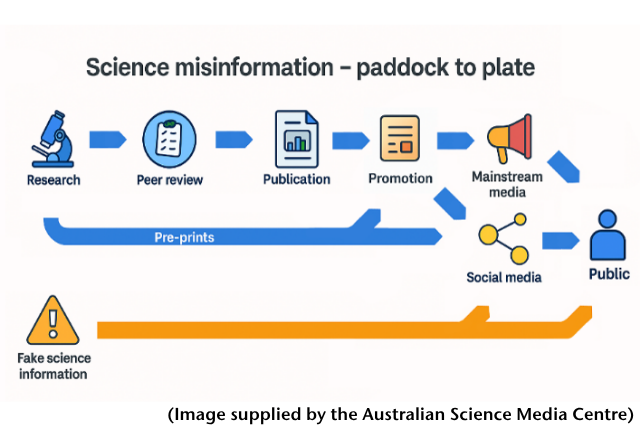
Scientific evidence takes time to progress from “paddock to plate”, from research, through to peer review, publication and promotion to the public. But misinformation benefits from speed.
Vectors include social media bots, community social media forums, “Big Wellness” influencers, overseas meme factories and, unfortunately, even news outlets.
Convincing but incorrect content, including fake videos, social media posts, news articles and audio can now be created with one AI prompt.
Newsrooms are under increasing pressure to publish engaging stories quickly and have less time to verify sources. Yet they’re required to sift through increasing amounts of AI-generated media releases and other content.
But the influence of AI is bigger than fake content. It also threatens to undermine scientific journal publishing.
AI can be used to quickly develop phony academic journal papers and what appears to be ‘scientific’ information.
Academics must continually publish new research. But predatory journals and paper mills are accepting and publishing papers without appropriate peer review. This creates the perfect breeding ground for misinformation.
Symposium presenters asked delegates, is the academic publishing system that prizes quantity of publications and citations over quality research part of the problem?
Also, how can we tackle the growing number of predatory journals and protect academics, the media, and the wider public from them?
- The ways people consume content has changed, and we must adapt
We live in an attention economy and unfortunately misinformation is often more entertaining and engaging than nuanced scientific evidence.
One speaker spoke about meme factories, often based overseas, which can spurt out endless content that is designed to go viral.
Within the public health community, we can’t just publish research on websites and in journals. We need to translate public health advice and evidence so it’s shareable.
This includes using personal stories to bring facts to life, creating content that captures attention on social media, and stepping up and reaching people where they consume information including within AI chatbots.
At the conference we heard from a scientist who developed a strong social media following dispelling myths about beauty products and sunscreen. We need to encourage brave public health experts and scientists to become content creators and “influencers”.
But we also need the resources to help public health researchers and professionals do this safely.
- Misinformation feeds off uncertainty
The science sector is usually comfortable with uncertainty, changing advice, and unanswered questions. It’s the nature of discovery and the evolution of knowledge. Science is not always absolute.
But for the general public, uncertainty, particularly about their health, often evolves into fear and leads to individuals seeking answers elsewhere.
Some fellow science communications professionals discussed the need for scientists to be upfront about what we don’t know, and make the unknown seem less daunting.
- We need to help people become misinformation detectors
Increasingly people are practicing news avoidance to protect their mental health. That means they aren’t always getting their information from trustworthy sources.
But no one likes being misled.
The symposium heard about programs to improve media and science literacy, particularly among younger generations.
The event hammered home that we need to help more of the Australian public think like a scientist – asking for the evidence, questioning sources, and expertly spotting misinformation out in the wild.
The sector also needs to do more to help journalists quickly identify a credible scientific publication, information and/or spokesperson.
- Science has become political
Delegates were asked “which is more dangerous – polarisation or misinformation?” The answer is both. Misinformation is closely linked to polarisation and they feed off one another.
One speaker highlighted a documentary that showcases examples of intelligent, thoughtful anti-vaxxers, who were driven further away from mainstream views after being attacked for holding different perspectives or asking questions.
Evidence presented at the conference suggested those most vulnerable to misinformation are socially isolated, lack access to information, and are fearful. We need to keep this in mind when we think about who we need to reach, and how we communicate with them.
The temptation might be to discredit, attack, or simply undermine someone who has a different view, but that only drives people further away and often further entrenches their scepticism towards science.
Sometimes (but not always) there is a constructive two-way conversation to be had.
- Science needs to get its own house in order
This means that scientists and their communicators need to protect their work from AI and misinformation, but also dramatically improve the way we communicate science to the broader public.
Some of the recurring themes included the need to put the brakes on overstating the significance of new scientific findings.
As one presenter commented with the daily news coverage new medical inventions in animal studies in labs, “it’s a great time to be a mouse”.
Communications professionals like myself need to avoid over-hyping results, better explain research methods, and admit the limitations of new research. We need to help the public understand the scientific process and explain why and when the latest evidence and advice might change over time.
We also need to admit if we got something wrong in order to maintain public trust.
But while toning down the hype, our messages and content must remain engaging.
- The jury is still out on the best evidence on myth-busting.
Does myth busting just reinforce a myth? Is responding to every piece of misinformation a waste of time? Can you “inoculate” against misinformation by exposing misinformation before it takes off?
There are lots of different theories out there about the best way to tackle misinformation, and like all good scientific questions, there’s no clear consensus. Our sector needs more robust conversations about public health myth busting and evidence about what works best.
But in the meantime, we can’t let misinformation float around unchecked.
We need to lead with the facts, with content that is engaging and cuts through the noise.
Want to find out more about the symposium and what was discussed? You can read the official white paper from the Australian Science Media Centre here.
Hollie Harwood is the PHAA’s Strategic Communications Adviser whose responsibilities include communications for our official journal, the Australian and New Zealand Journal of Public Health.
Leave a Reply