
Dr Jennifer Dunne & Dr Matthew Govorko
Trust in public health is vitally important.
On 29 February 2024, the PHAA WA branch, in conjunction with Healthway and the Australian Health Promotion Association, hosted an event exploring trust in health policy – or rather, the lack thereof – and the implications for public health.
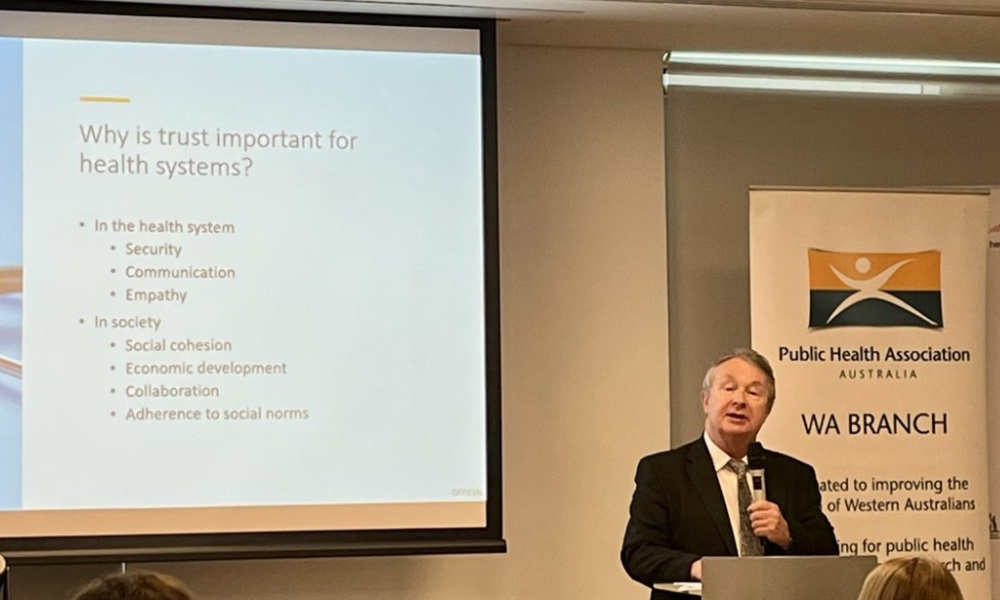
Martin McKee CBE, Professor of European Public Health at the London School of Hygiene and Tropical Medicine and research director of the European Observatory on Health Systems and Policies, joined us at the keynote speaker.
Professor McKee gave an insightful presentation on trust in public health and the consequences when that trust is missing.
He aptly noted that public health is ultimately political, and as public health researchers or practitioners, we have a duty to speak our truth to power.
This was exemplified by the pandemic, which made the importance of trust very clear – especially when things are uncertain, and action is needed.
Professor McKee spoke to three key sets of relationships that are integral to trust in public health and highlighted that these relationships must be reciprocal.
Trust in our health systems.
The public holds trust in our health systems, and it is vital that practitioners do not allow disinformation to proliferate.
Academics and public health practitioners have a moral obligation to call out politicians and others who spread falsities, with measures for handling disinformation to be central to every public health campaign.
Trust among health care workers.
Many health care workers felt neglected during the pandemic and consequently left their jobs.
Trust by politicians in the ability of health care systems to actively respond to changes in population health needs.
Having trust in our healthcare systems is important, and using clear, honest, and transparent communication is essential to gaining this trust.
Professor McKee reminded us that there is much work to be done.
As public health experts, we need to monitor the trust of the public, the patient, the health workers, and the politicians in our public health systems.
Listening to people whose lives are affected by our health care systems, building empathy, and actioning change is what makes effective public health leadership.

Professor McKee’s address was followed by a panel discussion, chaired by PHAA President Tarun Weeramanthri, and featuring public health experts; Dr Sandro Demaio (CEO VicHealth), Associate Professor Gemma Crawford (Australian Health Promotion Association), Joanne Graham-Smith (Healthway), and Professor Mike Daube AO.
It was an also exciting day for Healthway, with several board members and many staff in attendance to celebrate the launch of the Healthway Strategic Plan 2024-2029.
The panel covered a range of topics relevant to trust in public health, including the mental health crisis both here in Australia and in the UK, the commercial determinants of health, as well as the strong links between health and the justice system.
It was noted that there is a need to engage with young people in decision-making processes.
The panel reinforced Professor McKee’s earlier point about the importance of honest communication to build trust.
Broader topics covered in the panel discussion included gender, early career development, infodemiology, the importance of lived experience in community-led action, and emerging challenges facing public health related to new technologies and tactics by harmful industries.
Dr Demaio’s summary reinforced the overall message of the day – building trust is a responsibility of public health professionals. Some of his key messages included:
- Lessons and leadership matters – the shadows cast are important in building trust
- People trust people – be humble, honest, personable, and relatable
- People trust health but want a vision for change, not business as usual
- Include – listen and be led by communities
- Innovate – look to the systems and deeper structures leading to poorer health
- Invest – in early career professionals in public health / health promotion
Professor Tarun Weeramanthri, President of PHAA, closed the event by presenting Professor McKee with the PHAA President’s Award for his contribution to public health in Australia.
The event was a timely reminder of the importance of building and sustaining trust in public health.
We call on our fellow public health researchers and practitioners to be frank, fearless, and honest in our communications, to build essential trust in our healthcare systems.
On behalf of PHAA WA branch members, we would like to thank Professor McKee and the panel members for a very engaging and knowledgeable morning. This event was well supported and attended by public health practitioners and researchers in WA. We thank our members for their continuing support and work to improve the health of all Australians.
Image: Supplied / Professor McKee delivering his keynote address.
Leave a Reply